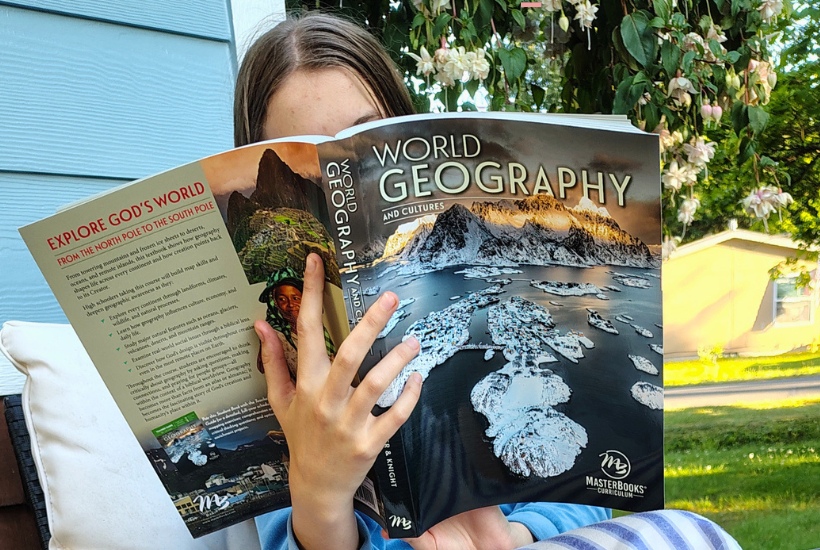
Master Books World Geography and Cultures: A Christian High School Geography Curriculum

This post may contain affiliate links. For more information, please read my disclosure policy.
This is a sponsored post in partnership with Master Books. I was compensated for my time reviewing this curriculum and writing this post. All opinions expressed are entirely my own.
If you’ve ever gone down the rabbit hole of trying to find a solid high school geography course, you know exactly how this goes.
You start out thinking, “I just need a geography credit.”
Three hours later, you’ve opened seventeen tabs and discovered that apparently your choices are either a glorified atlas (“Memorize these capitals and label these rivers”) or a textbook so dry your teenager checks out before you even make it to October.
And if you’re a Christian homeschool family like ours, there’s another layer to it. You don’t just want your kids to learn about the world. You want them to understand it through a biblical worldview.
This is why I was delighted to find Master Books’ World Geography and Cultures!
Why Geography Actually Matters in High School
Before I talk about the curriculum itself, I’d like to chat about why geography matters in high school.
Because I think it’s one of those subjects that ends up being ignored and overlooked too often.
Geography isn’t just maps and capitals. It’s understanding why people live where they do, how their environment shapes daily life, what resources they have access to, and how all of those things influence culture, conflict, economics, and community.
When our kids hear about a natural disaster, a war, or an event halfway across the world, geography gives them the context to understand why what’s happening there matters.
For high schoolers especially, that’s the kind of big-picture thinking I want to cultivate in my teens. A broader perspective than just our little corner of the world.
A good geography course doesn’t just check off a transcript requirement. It helps raise informed, compassionate adults who understand that the world is much bigger than their own backyard.
And that’s why finding the right curriculum matters.
Why Master Books World Geography Takes a Different Approach
This is what I loved about World Geography and Cultures.
Rather than focusing solely on populations, exports, climates, and borders, World Geography and Cultures invites students to explore why these details matter within the larger story of God’s creation.
Throughout the course, students are invited to see geography as part of God’s story. Every region, every culture, every landscape is explored through a Biblical lens. They’re encouraged to ask questions, notice connections, and think critically.
Not in spite of their faith.
Through it.
For instance, throughout the course, students are encouraged to pray for the people groups they’re learning about.
They’re not just memorizing facts about another part of the world. They’re being reminded that these are real people made in God’s image. It naturally builds mission awareness and compassion right alongside academic learning.
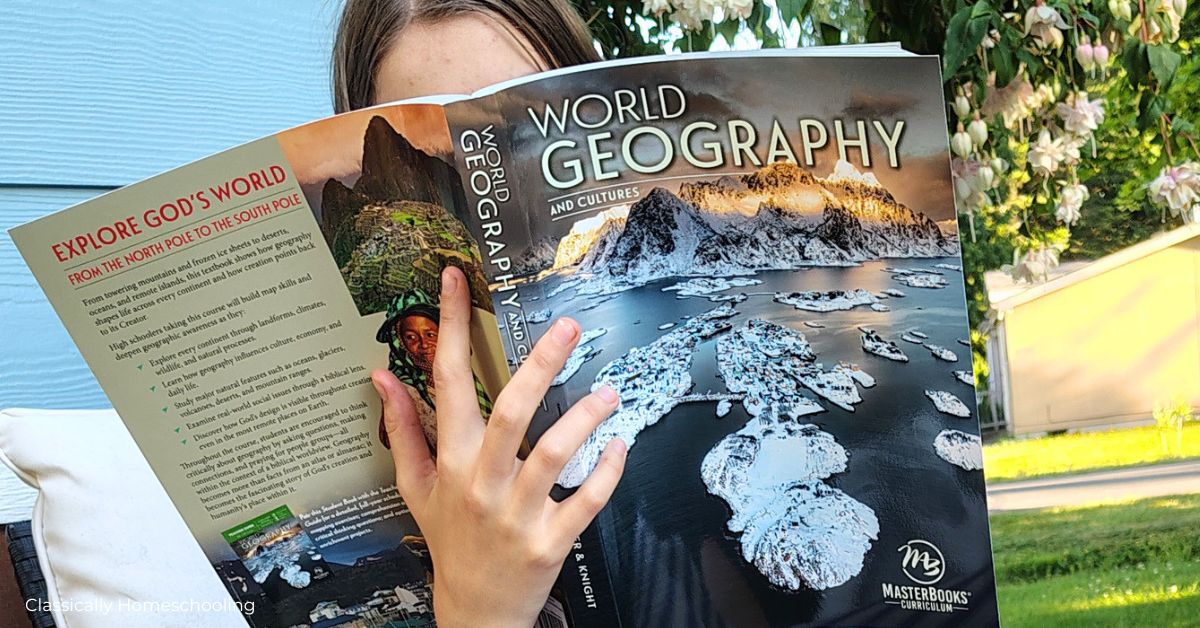
The way Master Books puts it is perfect: geography becomes more than facts from an atlas or almanac.
It becomes the fascinating story of God’s creation and humanity’s place within it.
Master Books High School Geography That Meets College Expectations
I’ll be honest—this is always one of my questions with faith-based curriculum.
I want my kids grounded in their faith, but I also want them prepared for whatever comes after high school. Maybe that’s college. Maybe it’s work. Maybe it’s a different path entirely.
I don’t want to choose between solid academics and a Christian worldview.
Thankfully, this curriculum doesn’t ask you to.
World Geography and Cultures aligns with geography content commonly included in college-prep World History and Geography courses, and it meets or exceeds the geography expectations of most four-year colleges.
I especially appreciate knowing that this course isn’t just academically solid for today’s homeschool needs. Whether your student needs a geography credit for graduation requirements or you’re preparing a transcript for a college-bound teen, World Geography and Cultures was designed to meet or exceed the expectations families are navigating right now.
Honestly, that was a relief. I didn’t realize how much mental energy I’d spent trying to balance those two priorities until I found a curriculum that handled both well.
Independent Learning? Yes, Please.
Can we talk about this for a minute?
Because if you’ve got multiple kids, work from home, have outside commitments, or simply don’t want to sit beside your teenager all day long…this matters.
A lot.
World Geography and Cultures was designed for teens to complete largely on their own. The instructions are clear, the expectations are straightforward, and the weekly schedule follows a repeatable pattern.
Your student knows what’s expected.
They know what to do next.
And they can get it done without you hovering over every assignment.
In my house, independent learning isn’t a bonus feature.
It’s survival.
And this curriculum really shines here.
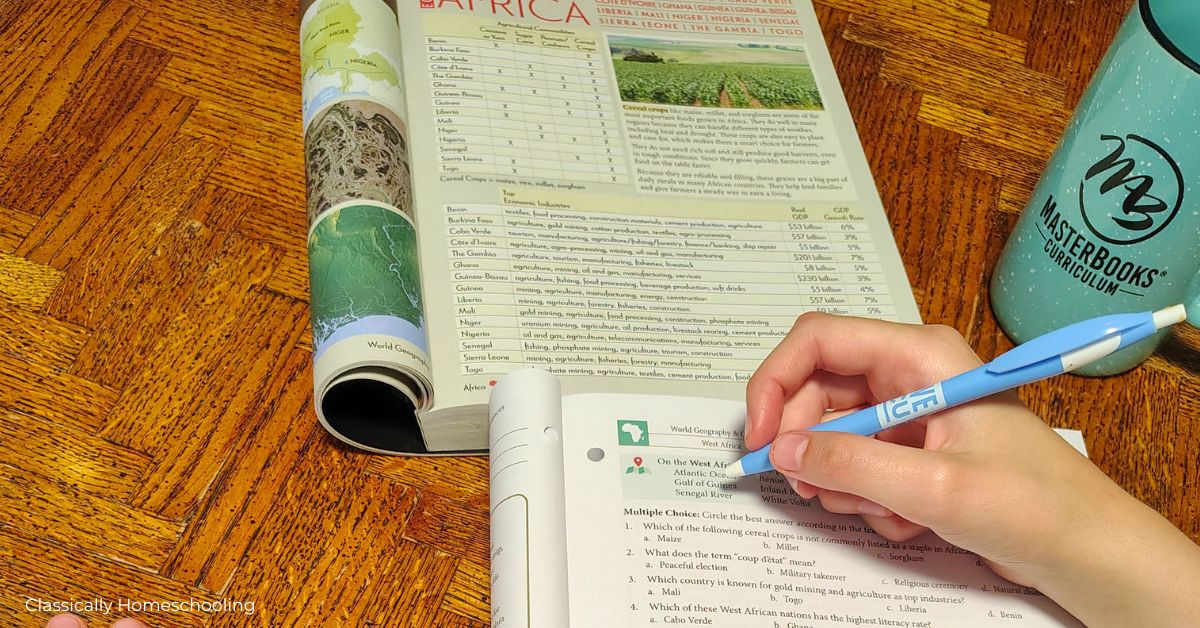
There are two components to the curriculum: the textbook and the teacher’s guide. The teacher’s guide not only includes the answer key, but it also includes a weekly lesson plan, student worksheets, and the daily map work.
It’s so easy to use! And the exercise sheets include the textbook page numbers and the page number for the daily map work as well. So your teenager doesn’t need to keep checking the weekly plan to find the relevant pages.
My daughter glanced at me and exclaimed, “The curriculum is so well organized!”
It Teaches More Than Geography
Plus, the course has a way of putting a human face on geography.
You’re not just learning that a region struggles with clean water access. You’re learning about the people living that reality.
Themes of stewardship and responsibility show up throughout the course, encouraging students to think about how people care for the land—and each other.
It builds compassion in our children.
And this curriculum doesn’t feel like it was designed by people trying to cram information into reluctant teenagers.
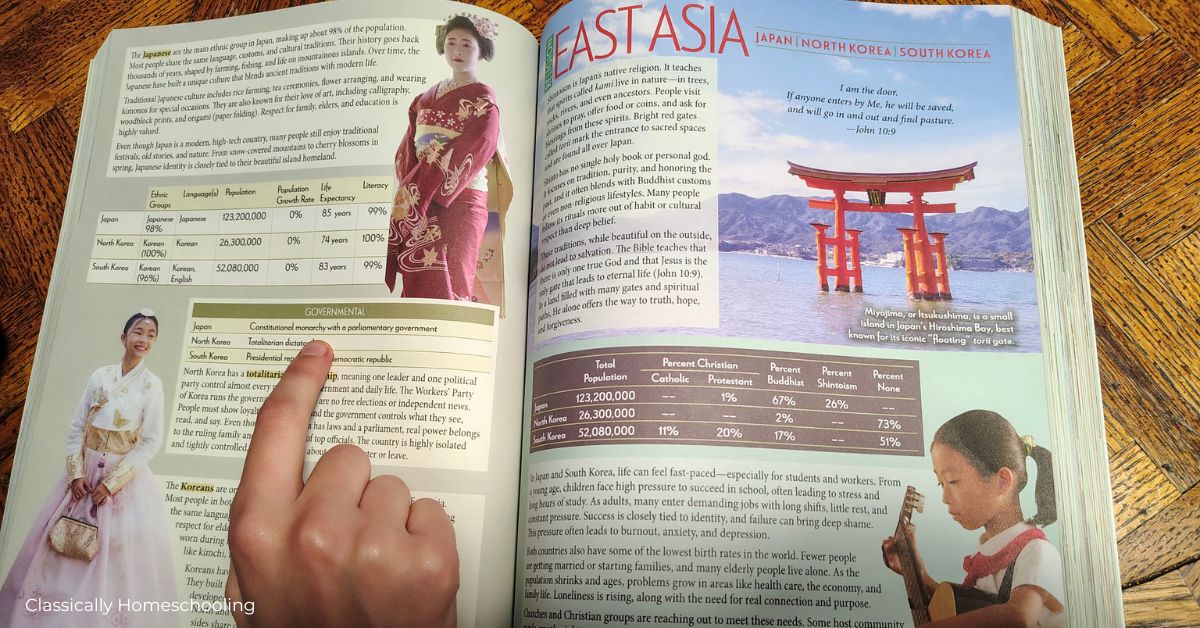
It feels like it was designed by people who genuinely want students to stay curious about the world God made. And interestingly enough, my daughter found the statistics fascinating! They give a quick snapshot of the area.
More Than a One-Year Curriculum
Here’s something practical I didn’t expect.
The textbook doubles as a really useful atlas and world almanac.
Need a visual for a history assignment? Grab it.
Trying to figure out where a country mentioned in the news is located? Pull it off the shelf.
Working on a research paper? It’s there.
I always appreciate when a curriculum keeps adding value long after the last lesson is finished.
What We Loved Most
For those of you who skipped ahead (I see you!), here’s the quick version:
- Christian worldview woven naturally throughout
- Meets high school and college-prep expectations
- Designed for independent learning
- Easy-to-follow weekly structure
- Encourages critical thinking
- Builds compassion and global awareness
- Doubles as an atlas and long-term reference resource
If you’re exploring options for a Christian high school geography credit, take a closer look at World Geography and Cultures to see whether it would fit your homeschool goals.
Final Thoughts
I think World Geography and Cultures is an excellent fit for Christian homeschool families with high school students—especially if you’re looking for a geography credit that doesn’t require you to compromise academically or spiritually.
It teaches the world.
It builds character.
It encourages compassion.
And throughout it all, it consistently points students back to the God who created this incredible world in the first place.
If geography has been one of those subjects you’ve struggled to find “the right fit” for, I completely understand. The search can feel endless.
So if you’ve been searching for a geography curriculum that combines strong academics, independent learning, and a thoroughly biblical worldview, I encourage you to take a closer look at World Geography and Cultures and see if it’s the right fit for your family.
And before you go, don’t forget to enter the giveaway for your chance to win!
Click here to enter!